Dilemma with a Kodak Specialist 2

WD-40 - well the original -- is the last thing you should use, except for feeing up locked items,

These days WD-40 is a trade name used for a variety of products including Silicone lubricant, Contact cleaner, Rust remover. I have used the original on vintage leaf shutters, however ensuring all traces are removed before final re-assembly.

Ian

I know you do a lot of older camera restoration. Have you ever tried candle wax or bee's wax as a lubricant for for sliding mortice surfaces?
 
I know you do a lot of older camera restoration. Have you ever tried candle wax or bee's wax as a lubricant for for sliding mortice surfaces?

Most of the cameras I restore (British & US) don't need lubricants, focus is rack and pinion. The exceptions would be the tongue & groove mechanism of almost all Reisekamera and Chambre de Vogae (German & French tail-board cameras) which lock a tail-board flat and also allow additional extension.

I use Bee Wax, the other times I use it are on the edges of the dark-slides of book-form plate holders. I notice on my can of Bee Wax it says "The Original Non Silicone Wood Silk".

Ian
 
Most of the cameras I restore (British & US) don't need lubricants, focus is rack and pinion. The exceptions would be the tongue & groove mechanism of almost all Reisekamera and Chambre de Vogae (German & French tail-board cameras) which lock a tail-board flat and also allow additional extension.

I use Bee Wax, the other times I use it are on the edges of the dark-slides of book-form plate holders. I notice on my can of Bee Wax it says "The Original Non Silicone Wood Silk".

Ian

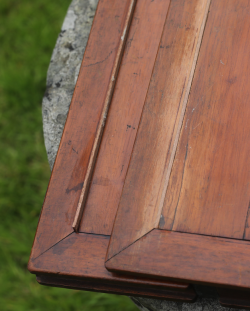
I ask because my Wisner Technical Field has a sliding wooden tongue and groove structure driven by a rack and pinion.

It's a bit tight because the wooden components seem to have warped ever so slightly - not enough to prevent use, but just enough to make it bind a bit. I've tried wax and that only helped a small bit. Once summer comes and the wood swells to max size, I am thinking about a small bit of sanding or shaving to improve clearances.
 
Sanding sliding component can leave a small residue of abraisive. Cameras are not subject to a great deal of movement (nothing like a steam engine, for instance) but the surfaces should be very well cleaned afterwards. A scraper might avoid this.
 
Sanding sliding component can leave a small residue of abraisive. Cameras are not subject to a great deal of movement (nothing like a steam engine, for instance) but the surfaces should be very well cleaned afterwards. A scraper might avoid this.

Fair point. I should have noted that - when I sand anything - I typically wipe it down with a tack cloth, in this case to be followed by a light wax, probably.
 
Central heating is not good for vintage wood & brass cameras, but it's even worse though when the wood is thin, like the dark-slides of book-form holders, cases of Thornton Pickard roller blind shutters, etc. I frequently have to repair the TP shutter casings, and wooden dark-slides split. It doesn't help that book-form holders weren't always glued, and if and when they were, it was bone glue.

I restored some 12"x10" plate holder last year, the wood had shrunk on the dark-slides. There were splits as well. Most importantly, the dark-slides were no longer long enough to fit the end light trap. I had to add new wood.

1744476261896.png

Sanding sliding component can leave a small residue of abraisive. Cameras are not subject to a great deal of movement (nothing like a steam engine, for instance) but the surfaces should be very well cleaned afterwards. A scraper might avoid this.

I'd check with a steel rule edge to see if there are hot spots that are out of true, first. Then decide what action to take. On the large dark-slides I used a very fine file, then 1200 grit paper to finish, then the Bee Wax.

Ian
 
You guys! We actually did it.

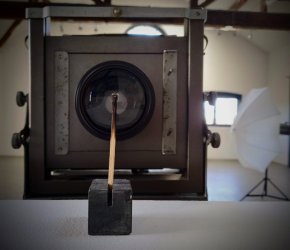
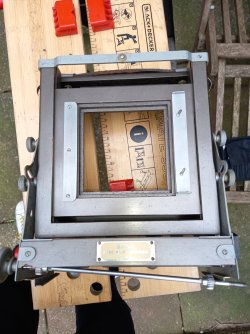
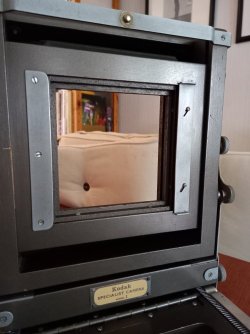
I ended up taking my dremel to the guides and shaving a bit of metal off each side, the part where it bows up slightly I guess to help lock it into the groove.

Everything else thoroughly cleaned up. The bellows are rolling on the track much more smoothly now, seem to be sturdy, aligned and the cleaning has also obviously helped.

Also look how grubby the lens board slots were (other metal parts were similarly dirty). Initially I had assumed this was rust and wouldn't clean up, but I decided to spruce that up too and now it looks very nice.

Thanks everyone for your input (also slightly surprised myself as it seemed like an arduous task before I started and I didn't think I would have the aptitude for it).

Very keen to get back at it and test out some proper film.
 

Attachments

  • kodak-2-a.jpeg
    kodak-2-a.jpeg
    97.1 KB · Views: 12
  • kodak-2-b.jpg
    kodak-2-b.jpg
    160.4 KB · Views: 12
  • kodak-2-c.jpg
    kodak-2-c.jpg
    106.8 KB · Views: 12
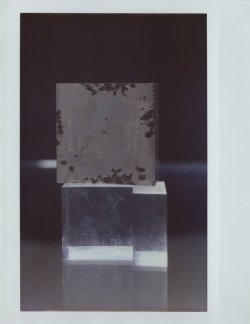
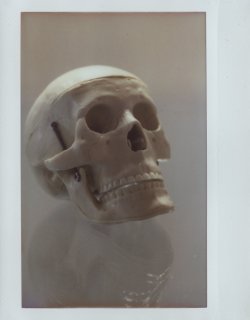
Here are a couple of tests I made with Instax (very happy with the lenses in both instances)
 

Attachments

  • blocks-5.jpg
    blocks-5.jpg
    59.7 KB · Views: 13
  • skull-3-nikon.jpg
    skull-3-nikon.jpg
    59.5 KB · Views: 13
Back
Top