Pyrocat HD FomaPan 200 EMA

Ian-Barber

Admin
Registered User
Joined
Aug 6, 2016
Messages
1,706
I was looking through some old notes I had developing with Pyrocat-HD but using the extended minimal agitation method on sheet film and I was curious as to how. it would work with 35mm.

Camera and Film
Contax 139Q
FomaPan 200 Rated at ISO 160

Scene
I chose a scene in the garden under very flat lighting. I chose 2 objects of interest ( garden fence and welcome spade ).
The subject brightness range between the two objects was just over 2 stops.

The fence was placed on Zone 2 1/2

Development
A few years ago when I tried semi-stand with 35mm how I ended up with quite a few streak marks along the edge of the negative when I used a Paterson tank so this was a concern.

I remember reading an article that @thronobulax wrote about raising the real in the tank so I got 2 collars, the ones you put over the spindle to stop the reel sliding, placed them over the spindle and then the reel on top to give me some clearence.

I mixed up 3.5ml of Pyrocat part A and 2.5ml of part B

Total development time 57 minutes
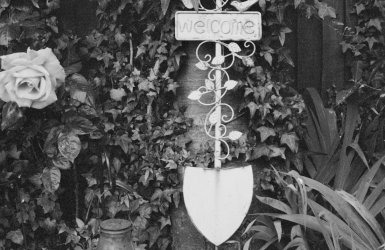
  • Presoaked the film for 3 minutes
  • Constant agitation for 3 minutes
  • Let is rest until 21.00
  • Agitate until 21:30
  • Rest until 39.30
  • Agitate until 40.0
  • Rest until 57.00
  • Stop, fix and wash as normal
  • Scanned the negative with no adjustments

Pyrocat-EMA-35mm.jpg
 
Last edited:
Really, you get better tonality with Fomapan 200 in Pyrocat HD processed normally.

Ian

At 1+1+100 would you be able to get the expansion?
The spade was only a couple of stops higher than the fence which was placed on Z 2 1/2 resulting in the spade resting on 4 1/2 - 5
 
At 1+1+100 would you be able to get the expansion?
The spade was only a couple of stops higher than the fence which was placed on Z 2 1/2 resulting in the spade resting on 4 1/2 - 5

Increasing dilution gives compression, not expansion, but a scan is subjective.

You have seen my John Blakemore, Fay Godwin, etc, original prints, no serious photographer uses EMA. The exception is ULF workers who can only contact print.

Ian
 
Decided to delete
 
Last edited:
Really, you get better tonality with Fomapan 200 in Pyrocat HD processed normally.

Ian

Clearly not true as literally dozens of other people have shown repeatedly. It all depends on the scene SBR, the developer dilution and the standing time. Also "processed normally" is pretty hard to nail down. "Normal" varies a lot by the scene, the film, the developer, and the way people meter.

The problem here is that the scanner is going to flatten contrast so figuring out the "real" tonality would require post processing which was not done here according to @Ian-Barber
 
Increasing dilution gives compression, not expansion, but a scan is subjective.

Yes, that's true with conventional development. The regular agitation refreshes the depleted solution at the highlights and continues to develop them. That's why N+ development works in traditional agitation regimens.

But high dilution to allow for a very long development time accompanied by infrequent agitation will:

  • Increase effective EI to very near box speed because the film is in developer for a long time which achieves full shadow speed
  • Expand the midtones because they benefit from the long development as well
  • And compress the highlights due to developer exhaustion with so little agitation.
This all comes, of course, at the cost of having to deal with bromide drag and negative streaking. That's why there is all the hocus pocus involving film suspension above the bottom of the tank, minimizing contact with the film and so forth that we've beaten to death in the past.

This is not an opinion. It's widely and repeatedly demonstrated by any number of people.

You have seen my John Blakemore, Fay Godwin, etc, original prints, no serious photographer uses EMA.

You are in danger of the No True Scotsman logical fallacy to try and defend a demonstrably false premise.


The exception is ULF workers who can only contact print.

Ian

I have also seen dozens of other photographers (other than me) who are quite serious who get great results with it. As just one example, take a look at the work and tests done by Andrew O'Neil over on Photrio. He does fine work. Is it your view that he isn't "serious"?

I also think that had Atget lived, he'd find your claim he wasn't "serious" sort of entertaining ;)

EMA and semistand work and work well in certain circumstances. They are not the only way to work and anyone claiming so is being foolish. But I'll go further - anyone claiming there is only one acceptable way to work for any methodology isn't right either.

In this case, since I don't know the capacity of the Patterson tank, I cannot determine the actual dilution ratio used and thus have no informed view on the outcomes here.

On a personal note, I am fascinated that you have never dug seriously into EMA and semistand. You're clearly quite accomplished and understand the chemistry herein. I think if you took a serious cut at this, you too would find circumstances wherein you'd find value in this method.

As I've explored this, I've slowly moved away from semistand and toward even higher dilution and longer time EMAs for normal or long SBRs because the method can overdrive contrast in unpleasant ways. For very short SBRs, I've been using semistand for an hour, which, honestly, is basically just like doing N+2 or N+3. The only advantage is that the super dilution drives nice acutance and edge effects.

But I still use PMK, D-23, and HC-110 for any number of things in their ordinary dilutions and agitation schemes. I even have many tins of DK-50 in residence, should that need arise ;)


More arrows in the quiver. No magic, but useful sometimes.
 
Last edited:
I was looking through some old notes I had developing with Pyrocat-HD but using the extended minimal agitation method on sheet film and I was curious as to how. it would work with 35mm.

Camera and Film
Contax 139Q
FomaPan 200 Rated at ISO 160

Scene
I chose a scene in the garden under very flat lighting. I chose 2 objects of interest ( garden fence and welcome spade ).
The subject brightness range between the two objects was just over 2 stops.

The fence was placed on Zone 2 1/2

Development
A few years ago when I tried semi-stand with 35mm how I ended up with quite a few streak marks along the edge of the negative when I used a Paterson tank so this was a concern.

I remember reading an article that @thronobulax wrote about raising the real in the tank so I got 2 collars, the ones you put over the spindle to stop the reel sliding, placed them over the spindle and then the reel on top to give me some clearence.

I mixed up 3.5ml of Pyrocat part A and 2.5ml of part B

Total development time 57 minutes
  • Presoaked the film for 3 minutes
  • Constant agitation for 3 minutes
  • Let is rest until 21.00
  • Agitate until 21:30
  • Rest until 39.30
  • Agitate until 40.0
  • Rest until 57.00
  • Stop, fix and wash as normal
  • Scanned the negative with no adjustments

I spent some time pondering this and - upon closer inspection - it feels like this has several things you might consider for your next run. I suggest these because while the image does separate the fence from the spade, the overall impression I get is of a somewhat overdeveloped scene with the midtone contrast kind of oddly emphasized.

  • I'm guessing that your tank is 500 ml which would put your dilution at 1.4:1:200. This likely isn't quite dilute enough for EMA for this long and it may be contribution to what looks to me anyway, like overdevelopment. I'd try 1.5:1:250 next.

  • There is considerable debate about whether prewashing is even necessary and, if done, how long is too much. The concern is that extensive prewash can actually impede development. I have moved to only 1 min of prewash for any style of film development I do, and may reduce that further, though this alone has shown no difference.

  • I think the initial agitation may be excessive for EMA. Perhaps try 90 seconds next time.

  • Ditto the intervening agitations. At your two other agitation points, try just doing so for 10 seconds each.
The overall resulting negative would likely have a lower CI but I think the local contrast might look better. You might try the above having shot several frames placing the wall on II and then on III. I find that Fompan 200 likes more exposure and lower contrast development to give me overall more pleasing results, but I primarily silver print so I don't know how such a negative might scan.

This kind of short SBR also works nicely with true semistand with 1.5:1:250 - one initial 2 min continuous agitation, one 10 second agitation at 31 min, and out at 60 mins. This amounts to the same thing as, say, an N+2 or N+3 with conventional agitation scheme. So why do it? To explore the resulting acutance and edge effects long, high dilution can give you. Semistand can put you a somewhat higher risk of drag effects but I think your technique to raise the reel with a 2nd collar may be sufficient.

Don't get discouraged. It takes a while to find what works for you. How you see "Zone II-IIl" and meter for it is almost certainly different than how I or others might. The goal here is to tune the process for you.

As an aside, I will say that I find Fomapan 200 really good when you find its sweet spot, but of all the films I use, it's the most fussy about controlling contrast and getting exposure right. But it can be done. Here is a workbook scan from a silver print of Foma 200 processed semistand as described above (noting that I should have burned the upper left and the lock face when I printed). The scene was an absolutely flat gray short SBR. Semistand made it pop:

 
Last edited:
At 1+1+100 would you be able to get the expansion?
The spade was only a couple of stops higher than the fence which was placed on Z 2 1/2 resulting in the spade resting on 4 1/2 - 5

Not if you use the normal time. But you could develop and agitate conventionally for a longer than usual time - N+ development - and get the tonal expansion you're looking for. There are several ways to skin this particular cat.
 
We are seeing words like “more pleasing” and “unpleasant results”.
These are matters of taste, not technique.
 
Back
Top