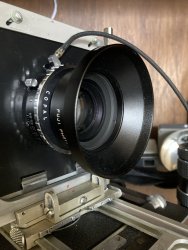
light leak?

S

Sevsuk

Guest
Hi all, this is my first post and wanted to see if some someone could share some advice. I bought the chamonix 45n2, with fujinon 125mm (wista / linhof board) and fidelity elite holders.

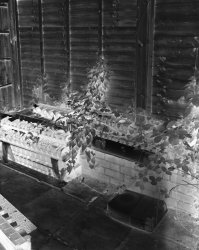
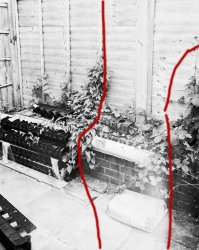
THe attached is the positive and negaitve of a test shot I took in the garden. Theres a light leak / over exposed part on the negative. I cant work out why this is?? THe lens baord is correctly inserted into the front standard, the exposure is correct. Can someone please help?
 

Attachments

  • 45n2 (1 of 1)RED MARK.jpg
    45n2 (1 of 1)RED MARK.jpg
    182.9 KB · Views: 18
  • 45ns_garden_portrait_neg.jpg
    45ns_garden_portrait_neg.jpg
    157.4 KB · Views: 17
The most likely thing is that when you inserted the dark slide, it wasn’t seated quite properly. The second is that the light seal is imperfect or you were a bit clumsy in inserting or removing the sheath. Did you insert a corner first? It’s unlikely, but is the camera back securely attached?
It’s just possible that there’s a pinhole in the bellows but the shape of the flare is unconvincing for that.
You don’t say how you develop, but that could be a further opportunity for flare to pounce on your innocent and trusting negative.
But keep up the good work. Nothing wrong with what you’ve done.
 
Light leaks can be very difficult to find amd then resolve. Some years ago I borrowed an MPP Micro Press to compare what parts where actually made by Graflex and what by MPP. Just before returning it he owner asked if I could trace the light leak, I tried a torch iside the bellows in the darkroo, with no luck. In the end I stuck a flash gun isode the camera and bellows makig sure the flash lead throungh the front standard was light tight.

It turned out the leak was where the bellows attached to the rear of the camera, even with a flash it was only just detectasble, but enough to cause an issue.

That could easily be a pin-hole in the bellows on an outer fold, usually a corner, they are rare on inner folds.

Ian
 
The most likely thing is that when you inserted the dark slide, it wasn’t seated quite properly. The second is that the light seal is imperfect or you were a bit clumsy in inserting or removing the sheath. Did you insert a corner first? It’s unlikely, but is the camera back securely attached?
It’s just possible that there’s a pinhole in the bellows but the shape of the flare is unconvincing for that.
You don’t say how you develop, but that could be a further opportunity for flare to pounce on your innocent and trusting negative.
But keep up the good work. Nothing wrong with what you’ve done.

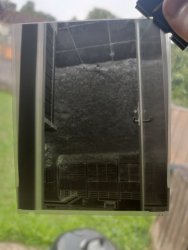
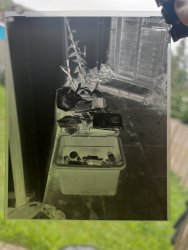
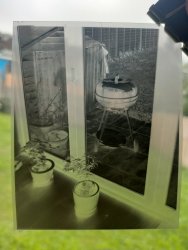
Thanks David for the comments. I developed the film at home. I use a sous vide to manage the temperature of the chems, so fairly stable. I had a play again this morning checked that the lens board and the back plate were secure. These four negs are now perfect, so maybe I'm thinking lens flare, as the original negative (with red mark) had bright sun. Anyway thanks for your comments, much appreciated.
 

Attachments

  • IMG20210812102209.jpg
    IMG20210812102209.jpg
    71.4 KB · Views: 3
  • IMG20210812102137.jpg
    IMG20210812102137.jpg
    88.9 KB · Views: 3
  • IMG20210812102126.jpg
    IMG20210812102126.jpg
    85.8 KB · Views: 3
I use quite deep hoods on my Fujinon lenses ... as they seem quite flare prone ...
 
Hi Marley. Thanks for this.

I just can't get on the digital camera scanning. I'm using my v600. Scans 1/2 the nagative at a time. It's overcast today some I'm off to try again.
 
Hi Marley. Thanks for this.

I just can't get on the digital camera scanning. I'm using my v600. Scans 1/2 the nagative at a time. It's overcast today some I'm off to try again.
Could be tighter, but this hood lives on my 150mm
20210812_141814085_iOS.jpeg
 
Back
Top