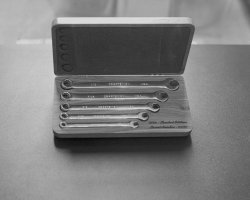
Certainly a worthy first effort. Certainly much better than my first

Just a reminder - most panchromatic films like Foma will loose 1 full f-stop of effective speed under tungsten light. So if the daylight ASA is 200, the indoor (tungsten) ASA is 100.
Moreover, - depending on how you develop and what developer you use - you will also discover that few films really hit rated speed in conventional development. I have not used DD-X so I have no specific guidance here. By way of example, though, if using ID-11/D-76 or HC-110B, I would rate that film at ASA 50 indoors and
underdevelop about 20% from the documented recommendations.
This is because ASA rating of modern film is sort of like mileage estimates on new cars - useful for comparing one against one another but not accurate for practical use. With most developers and standard agitations I have consistently found - after extensive testing - that the effective ASA is about 1/2 rated ASA if you want strong negatives. This causes the shadows to be fully exposed but runs the risk of blowing out the highlights, hence the slight underdevelopment. Again, I've not used DD-X so cannot comment.
This whole business has been discussed and documented in extensive detail under the rubric of "Zone System".
P.S. There are esoteric techniques for achieving full film ASA under daylight lighting but they are complex and not for the faint of heart. They also engender intense religious wars as to their effectiveness or value. You will see these named as "Stand", "Semistand", and "Extreme Minimal Agitation" techniques but they are primarily for the experienced practitioner. I mention them only because you may see reference to them here and elsewhere. You may safely ignore them.